Austria’s Natural Science Book of the Year 2017
Financial Times Best Books of 2015.
Financial Times and McKinsey Business Book of the Year Award 2015 longlist
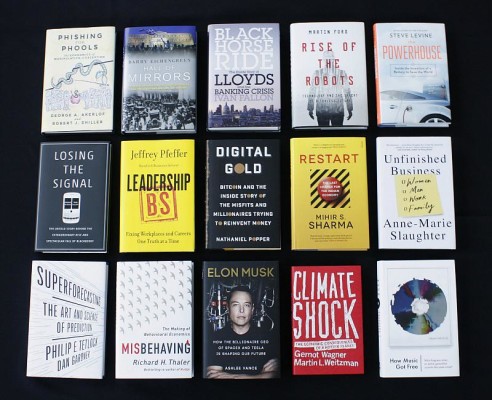
“Top 10: Business & Economics” for Spring 2015.
Financial Times Summer Book 2015.
Independent Publisher Awards (IPPYs) Gold Medal winner as one of the “2016 Outstanding Books of the Year,” winning in the “Most Likely to Save the Planet” category.
“Klimaschock ist ein wohlinformierter…leidenschaftlicher Aufruf zu Handeln” [German: “Climate Shock is a well informed…passionate call for action.”]
“Go Set a Watchman” isn’t the only book this year that brings new perspective to an old story line. “Climate Shock: The Economic Consequences of a Hotter Planet” should shift our narrative on climate change.
Climate Shock: The Economic Consequences of a Hotter Planet by Gernot Wagner and Martin Weitzman comes into its own here, emphasizing the centrality of uncertainty and the role of climate policy as planetary risk management. The authors are very good at arguing that uncertainty is not an excuse for doing nothing or for a wait-and-see policy.
Weitzman and Wagner offer a profound insight with their explanation of how the risks associated with a changing climate require new modes of economic thinking. […] Climate Shock breaks down a huge variety of highly technical complex environmental and economic concerns into short manageable chunks.
In Climate Shock…economists Gernot Wagner and Martin Weitzman deliver a stinging slap to the reluctant or somnolent [climate] negotiator. They creatively reframe climate change as a risk management issue — asking why, if there is a 10% chance that climate change will lead to catastrophe, we are not girding ourselves through ‘insurance’, such as pushing industry and policymakers to get on with the transition. They marshall excellent evidence to show that the longer the world waits to act, the likelier it will be that extreme events will happen. A welcome reminder that we must avoid becoming lobsters dawdling at the bottom of a slowly boiling pot.
Climate Shock, a punchy new book by Gernot Wagner of the Environmental Defense Fund and Martin Weitzman of Harvard University, explains why action is both so difficult and so important. The challenge is “almost uniquely global, uniquely long-term, uniquely irreversible and uniquely uncertain”. The book’s big contribution is on the last point: uncertainty. Climate change is a problem of insurance. For this, it is not median outcomes that matter most, but the outliers — the “fat tails” of the probability distribution of temperature.
[Climate Shock] is a witty, far-ranging, and literate set of observations, […] it is always informed by a deep understanding of the complexities of economics and particularly the difficulties of reaching international environmental agreements.
[Climate Shock is] a call to arms for business owners and leaders, economists, and policymakers.
[Climate Shock] is both a tidy summation of the state of the art in climate economics and a powerful call for action.
[A] lively, lucid assessment of the economic consequences of global warming.
Climate Shock is refreshing in many ways: it starts with a pop quiz, reveals the script of a (possible) new James Bond film and gives you the solution to climate change on page 23. That should be enough to entice a broad readership. However, the book’s true value lies elsewhere, in the authors’ ability to present a complex and multifaceted topic in plain, simple terms. They challenge assumptions and don’t shy away from a clear call for action.
Economists Gernot Wagner and Martin Weitzman deliver a highvoltage shock in their analysis of the costs of climate change.
The book combines sophisticated analysis with a breezy, informal style.
This is an outstanding book for anyone who would like to get the bigger picture of how human beings are exposed to climate change risk.
[I]nformative, convincing, and easily read.
Gernot Wagner and Martin Weitzman’s Climate Shock explores two of the most alarming risks from climate change: the unpredictable catastrophes and the all-too-foreseeable human tampering with the environment. They explain how the same political barriers to addressing the problem will leave nations racing to deflect the damage…through geoengineering. For anyone interested in the new risk landscape of our changing climate, Climate Shock is a compelling and highly recommended read.
Climate Shock looks at the key issues in climate change and climate change policy and recommends what actions readers can take to help prevent devastating outcomes. Wagner and Weitzman don’t hold back from explaining complicated topics and their arguments are backed by references from the latest scientific and economic literature. This is by far the most engaging presentation of this topic that I have read.
Do you want to be challenged and stretched? Climate Shock gives you broad perspectives and logical tools that will let you think through the threat of climate change on the level of the best minds on this planet.
The recent financial crisis was largely the result of an economy set up to privatize benefits and socialize costs. The same holds true for the climate crisis. Let’s avoid doing to the planet what we did to the economy, and let’s begin by taking the economics of climate change seriously. Climate Shock shows conclusively how bad the problem truly is and how we can fix it.
Climate Shock is a clear, well-argued introduction to the economics of climate policy.
Climate Shock fascinates, infuriates, motivates. It’s an illuminating guidebook to how the climate debate will unfold over the coming decade. But first and foremost, it’s a call to action. Now.
Think climate change is a low priority problem? Something to put off while we deal with more immediate threats? Then Climate Shock will open your eyes. Leading economists Wagner and Weitzman explain, in simple, understandable terms, why we face an existential threat in human-caused climate change. The authors lay out the case for taking out a planetary insurance policy, without delay, in the form of market mechanisms aimed at keeping carbon emissions below dangerous levels.
I cannot think of a better team than Wagner and Weitzman to communicate the risks of inaction on climate change. Their unbiased and informative book Climate Shock dives right into the complexities of the issues and explains them clearly. It provides new and invigorating context for readers.
In this clear and engaging exegesis on the risks from global warming, Wagner and Weitzman show that our options for avoiding calamity rapidly narrow toward a few unappetizing possibilities if we don’t slash carbon emissions comprehensively and fast.
A remarkable book on climate change, Climate Shock is deeply insightful, challenging, eye-opening, thought-provoking, and sheer fun to read. It will help you to think clearly and incisively about one of the most important issues of our generation.
What happens when one of the world’s leading economists who thinks seriously about global climate change gets together with one of the world’s top writers about matters environmental and economic? Climate Shock. From the first page to the last, this important, new book is both exceptionally interesting and surprisingly fun. Now, that’s shocking!
Climate Shock…demolishes the argument made by climate change skeptics for business as usual.
Climate Shock is a brilliant, clear, rigorous, and to-the-point account of the problem of climate change and what we can and should do about it. The book’s approach to risk—which factors in deep uncertainties—is vastly more sophisticated than the standard methods. An outstanding book.
Cutting through the fog of excuses, obfuscation, and misguided solutions, Climate Shock takes a clear look at the risks and dangers of inaction on climate change. Wagner and Weitzman show the urgent need for fact-based, rational analysis of big environmental challenges so that we can move forward in the quickest and most practical way possible.